The Office of Superintendent of Public Instruction (OSPI) has released its Statewide Civil Rights Review Legislative Report. On the surface, it looks like a technical audit of school district compliance with federal and state nondiscrimination laws. But beneath the bureaucratic language lies a deeper story: the expansion of state power into local schools, the imposition of ideological mandates around gender and sexuality, and the erosion of parental authority.
For families in Washington, especially eastern Washington and in rural communities, this report is not just about compliance. It is about control. And it confirms what many parents already know: Olympia is determined to override local values and elected school boards in the name of “equity.”
What the Report Says
OSPI’s review found that most districts meet baseline requirements under federal civil rights laws. But rural and smaller districts were disproportionately flagged as “out of compliance.” The reasons cited include:
- Limited administrative capacity to implement complex nondiscrimination mandates.
- Lack of staff training on civil rights obligations.
- Inconsistent implementation of policies tied to gender identity and sexuality.
The report recommends expanding OSPI staffing to conduct proactive reviews and enforce compliance more aggressively. In other words, more state oversight of local schools, especially those that have resisted or struggled to adopt the state’s gender-inclusive mandates.
Gender and Sexuality Compliance
One of the most striking aspects of the report is its emphasis on gender-inclusive schools. Districts are required to:
- Adopt policies and procedures that explicitly prohibit discrimination based on gender identity and gender expression.
- Publish notices in student handbooks and on district websites informing families of these rights.
- Designate a Gender-Inclusive Schools Coordinator alongside Title IX and Section 504 coordinators.
- Train staff annually on nondiscrimination obligations, including how to treat students consistent with their gender identity.
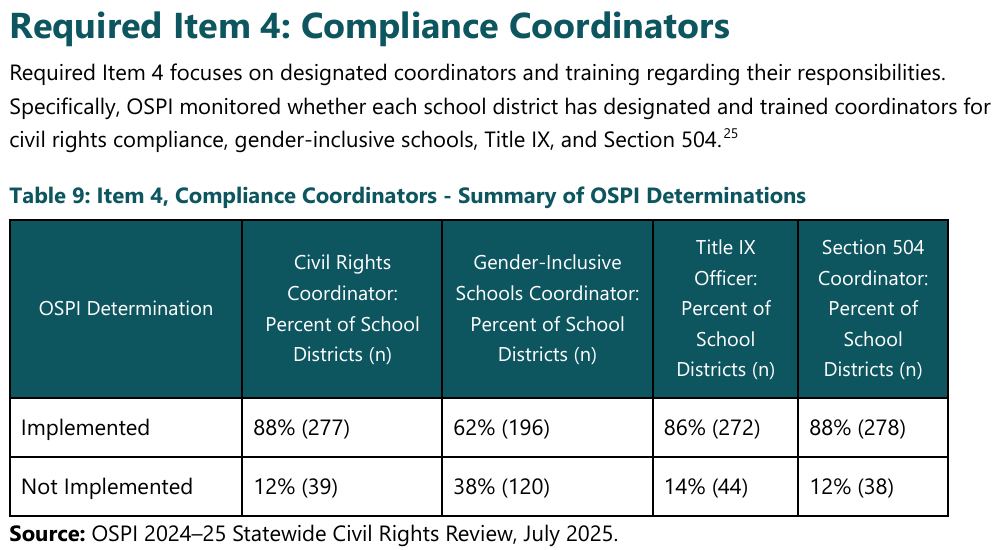
These requirements go far beyond traditional civil rights protections. They embed gender ideology into the compliance framework, making it a formal part of OSPI’s monitoring checklist. Districts that fail to adopt or enforce these policies are marked “out of compliance.”
For many rural communities, this is a direct clash between state mandates and local values. Many parents believe these policies undermine parental rights, confuse children, and impose ideological definitions of gender and sexuality that do not reflect their community standards. Yet OSPI treats noncompliance as failure, not dissent.
Local Resistance: School Boards Push Back
While OSPI frames its civil rights review as a neutral compliance exercise, the report itself acknowledges that many school boards have taken independent action, sometimes in direct opposition to state mandates. In reviewing board agendas and minutes from the 2024–25 school year, OSPI documented a range of resolutions that reveal how communities are resisting centralized control.
- Immigration Enforcement: At least 49 school boards passed resolutions limiting immigration enforcement in schools or explicitly protecting the rights of undocumented students. These actions reflect local priorities that differ from OSPI’s compliance checklist.
- Equity & Inclusion Initiatives: At least 20 boards adopted policies related to diversity, equity, and inclusion, ethnic studies, world religions content, racial equity in modernization projects, and heritage or awareness months. While OSPI highlights these as positive steps, they also show how boards are tailoring equity work to their own communities.
- Opposition to Gender-Inclusive Mandates: Most significantly, at least 35 school boards considered or passed resolutions opposing Washington’s gender-inclusive schools policies or enforcement. Some also supported changes to Washington Interscholastic Athletics Association (WIAA) rules regarding transgender student participation in athletics. These resolutions demonstrate that local boards are not simply rubber-stamping Olympia’s agenda — they are actively resisting policies that conflict with community values.
This section of the report is critical because it undermines OSPI’s narrative that noncompliance is merely a technical failure, requiring more OSPI staffing to fix this. In reality, many districts are making deliberate choices to push back against mandates they see as harmful or misaligned with local standards.
For parents and advocates, this is proof that resistance is possible and that local boards, even under heavy state oversight, can still reflect the values of their communities. It also shows that OSPI is well aware of this opposition, which is why the report recommends expanding staffing and technology to monitor and enforce compliance more aggressively.
But even as local boards push back, parents themselves remain locked out of the process. The report makes clear that compliance is judged by OSPI, not by families, and that’s where the transparency gap becomes impossible to ignore.
The Transparency Gap
Parents are told schools must comply with nondiscrimination laws, but they are denied access to many aspects of student records and decision-making processes. Notices may be buried in handbooks or websites, while complaint procedures are designed to flow through state channels rather than local accountability.
This means parents cannot meaningfully review how these policies are being applied to their children, even as OSPI expands its oversight. Accountability without parental review is not accountability at all.
Rural Schools in the Crosshairs
The report singles out rural districts as disproportionately “out of compliance.” But this is not simply a matter of resources, it is a matter of values. Rural communities do often lack the administrative capacity to implement complex mandates, but more importantly, they also resist policies that conflict with their standards.
Instead of offering flexibility, OSPI frames this resistance as failure and recommends more enforcement. The result is a narrative that rural schools are broken, when in reality they are standing firm against ideological mandates that do not reflect their communities.
This report confirms what many families already know: Washington’s public schools are being reshaped by centralized mandates that prioritize ideology over education. Compliance is being used as a weapon to enforce gender ideology and uniform standards, regardless of whether they reflect the values of local communities.
Local boards are stripped of authority. Parents are denied oversight. And children are caught in the middle of a system that values compliance with Olympia’s ideology more than alignment with family values. And most of all, they are not getting the academic education that they deserve.
Call to Action
We know OSPI and the legislature are unlikely to change course. That’s why our call to action must focus on what parents can do to reclaim authority and protect their children:
- Build Alternatives: Form homeschool co-ops, private micro-schools, and faith-based academies that reflect community values.
- Expose the Disconnect: Document and share how state mandates conflict with local standards. Use local watchdog groups to keep the issue visible.
- Hold Boards Accountable: Even if constrained, local boards must answer to parents. Show up, demand transparency, and make them publicly acknowledge where state mandates override local authority.
- Mobilize for the Future: Begin recruiting and supporting candidates for school boards and legislative seats who will defend parental rights and local control.
Closing Thoughts
Washington’s public schools may be beyond repair in the near term. But our children are not. We will reclaim education by building alternatives, demanding transparency, and standing together as parents and communities.
This isn’t just about compliance. It’s about control. And we refuse to surrender ours.
Support Our Mission
Conservative Ladies of Washington is a 501(c)(4) citizen-run political watchdog organization committed to exposing harmful education policies and defending parental rights. Your donation helps us mobilize families, produce investigative content, and fight for academic excellence in our schools.