
Senator Lisa Wellman (D) has filed SB 6261, a bill that significantly expands state oversight of young children who are not yet subject to compulsory attendance. While some elements of this bill mirror existing law, the scope of who the law applies to is being expanded downward and that shift deserves serious attention from parents, homeschool families, and anyone concerned about government creep into early childhood.
What SB 6261 Does
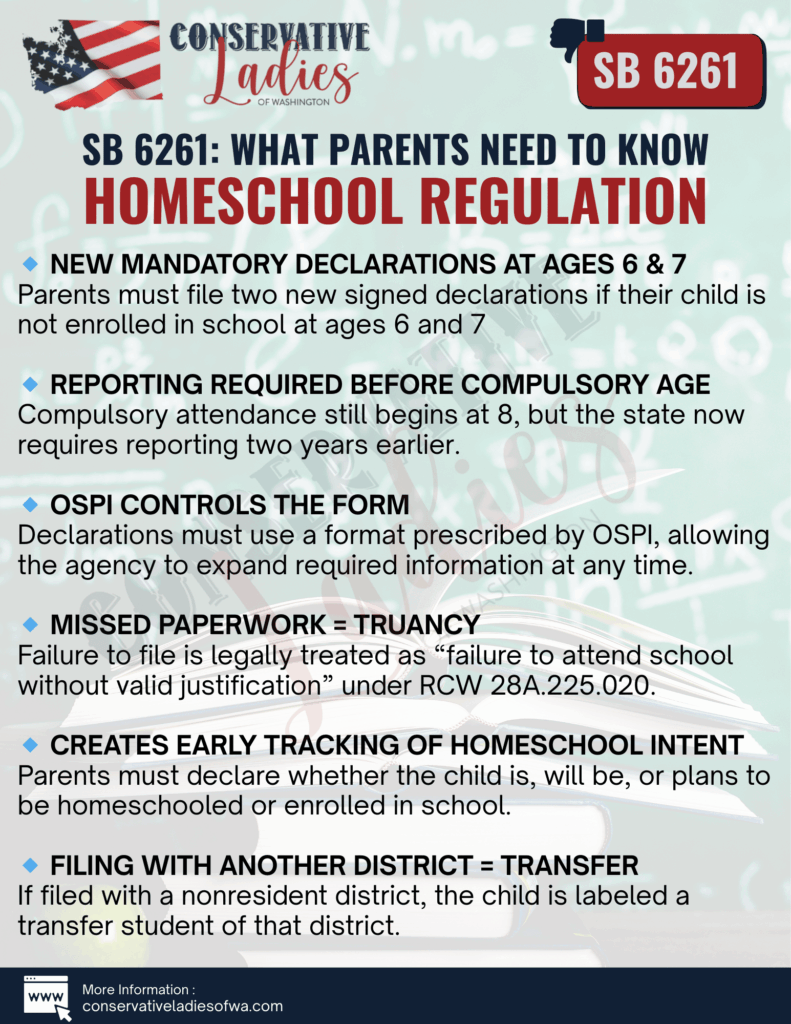
SB 6261 requires parents of children who are six and seven years old to file new signed declarations with their local school district if the child is not enrolled in public or private school.
These declarations must state whether the child:
- Is receiving home‑based instruction
- Will be receiving home‑based instruction
- Plans to be enrolled in school
This is in addition to the existing Declaration of Intent (DOI) required at age 8 and above.
What’s Already in Law — and What’s New
Some people have noted that parts of this bill resemble existing homeschool statutes. That’s true, but the application of those statutes is being expanded in ways Washington has never done before.
Existing Law (Not New)
- OSPI already has authority to prescribe the format of the Declaration of Intent.
- Failure to file required paperwork has long been treated as “failure to attend school without valid justification” under RCW 28A.225.020.
- Filing a DOI in a nonresident district already triggers “transfer student” status.
What Is New
- Two new mandatory declarations for children under compulsory age (6 and 7).
- Applying truancy‑related enforcement mechanisms to children who are not legally required to attend school.
- Requiring parents to declare future educational intentions, something not previously required in Washington law.
- Expanding OSPI’s authority from one form (the DOI) to three forms, increasing the agency’s regulatory footprint.
- Creating a new state‑managed paper trail for children two years earlier than ever before.
The mechanisms may be old, but the population they now apply to is new, and that is the heart of the concern.
Why This Matters
Washington has long held one of the latest compulsory attendance ages in the country (age 8). SB 6261 does not change that age …yet, but it creates the infrastructure to do so.
By requiring:
- early reporting,
- early tracking, and
- early declarations of intent,
The state is laying the groundwork for a future push to lower the compulsory age. Once the reporting structure is in place, lowering the compulsory age becomes a simple amendment rather than a major policy shift. This has been a priority for many years, so the expansion in future sessions is certain.
This is classic mission creep:
- First, require paperwork before compulsory age.
- Next, normalize state oversight of younger children.
- Then, argue that since families are already reporting at 6 and 7, compulsory attendance should “match the reporting.”
And we know how this goes; in future sessions, the argument will be that compulsory attendance should begin at 6, or even 5, because “the system is already in place.”
Bottom Line
SB 6261 represents a significant expansion of state authority into the early years of childhood education. While some mechanisms mirror existing law, the application to 6‑ and 7‑year‑olds is entirely new and sets the stage for lowering the compulsory age in future legislative sessions.
Parents and homeschool families should pay close attention. This bill is not simply a “clarification”, it is a structural shift toward earlier state involvement in family educational decisions.
Call to Action
Click the button below to track this bill and to send a message to your legislators asking them to oppose it!
Help Us Keep Up the Fight
We’re committed to truth, transparency, and empowering citizens with facts that matter. Your support helps us monitor policy, create rapid-response content, and mobilize families around critical issues. Donate now to fuel our mission! Thank you!