
When Democrats in deep-blue states pitch a bill called “protecting emergency responders,” experience says you should slow down, pop the hood, and read the fine print.
Washington’s HB 2216 is a perfect example.
At first glance, the bill appears to respond to real concerns like natural disasters, emergency response coordination, and interference with first responders. Given recent flooding and emergency events in Washington, that framing sounds reasonable.
But HB 2216 isn’t just an emergency responder bill.
It’s a sanctuary state expansion wrapped in disaster-response language, a legislative sandwich where the top and bottom layers sell public safety, while the middle quietly hard-codes statewide resistance to federal immigration enforcement.
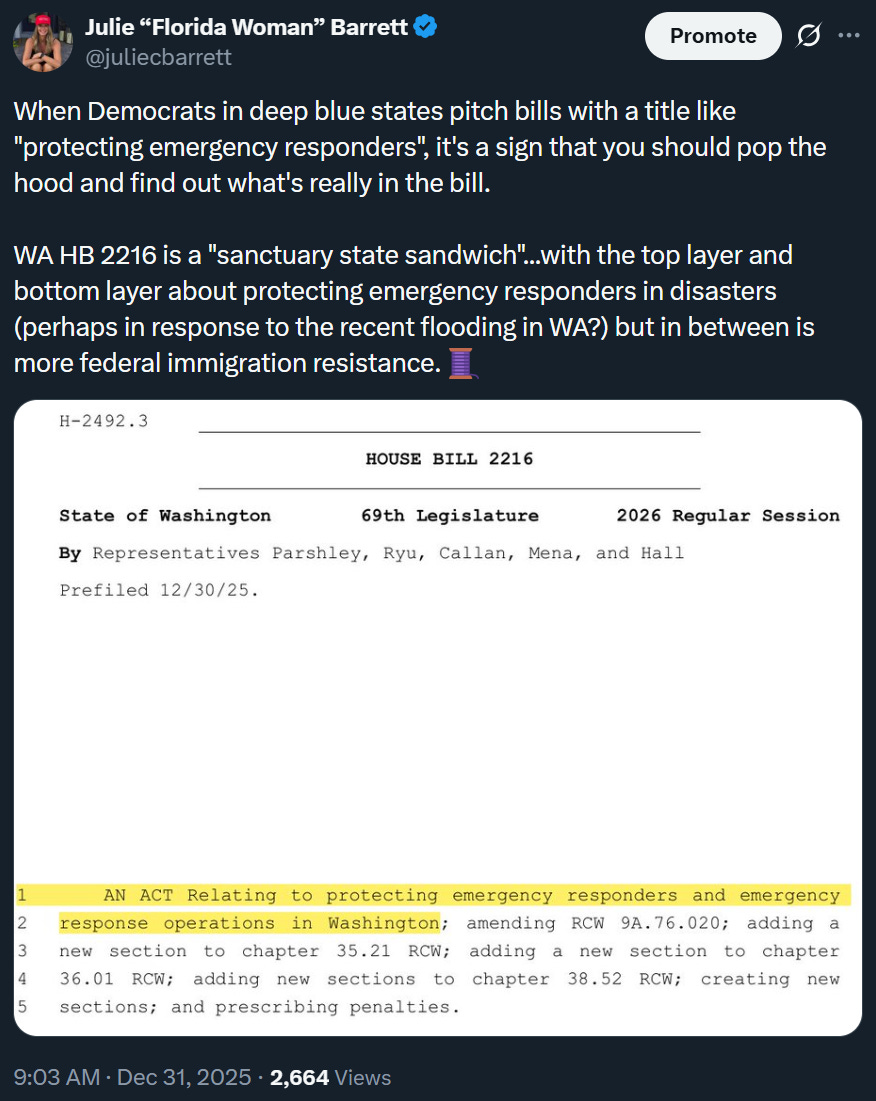
The Middle of the Sandwich: Statewide Sanctuary Codified
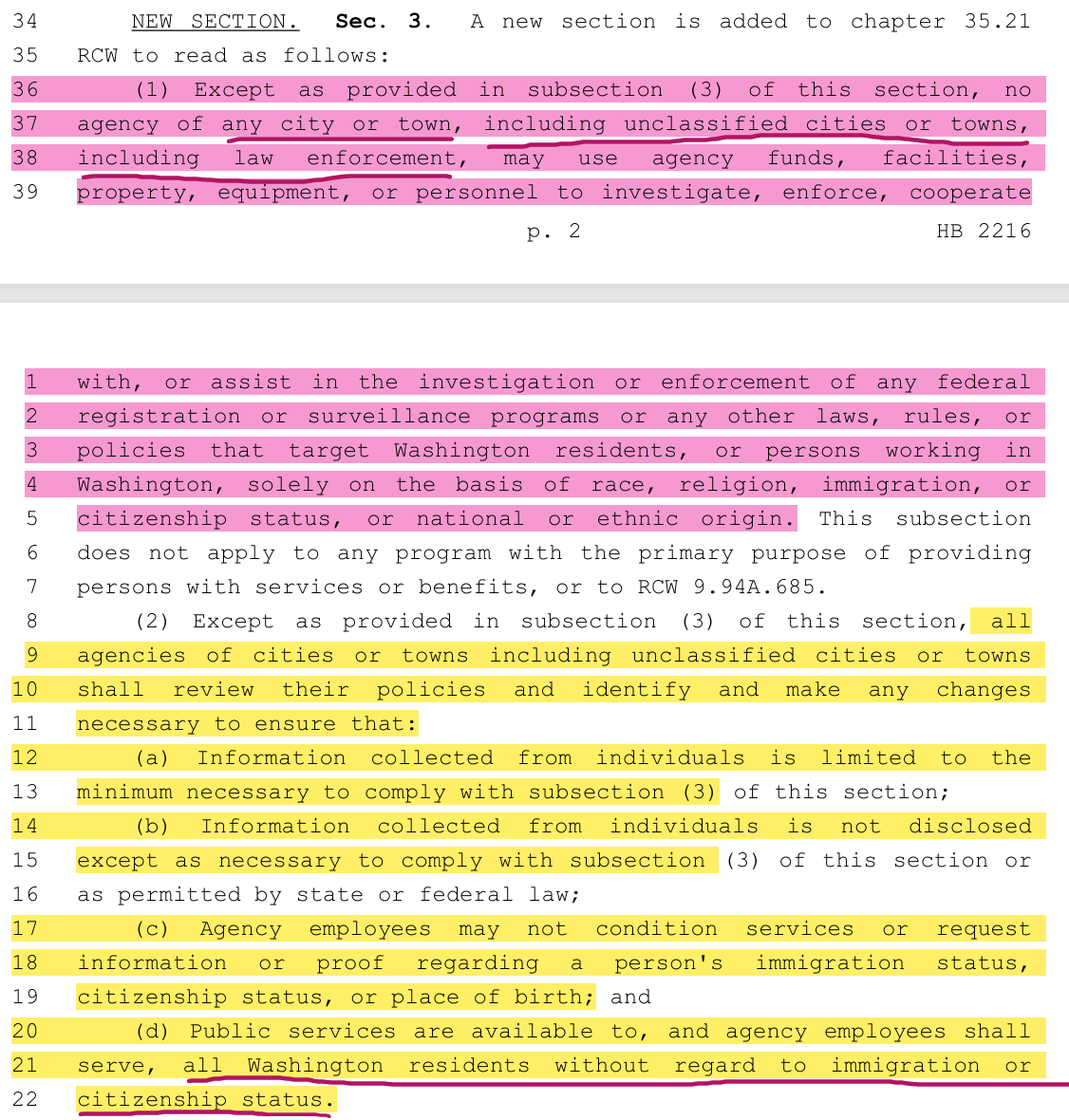
Sections 3, 4, and 5 are where the bill fundamentally changes state policy.
Section 3 creates a uniform sanctuary framework for all cities and towns in Washington. Under HB 2216, cities and towns may not use public funds, personnel, or equipment to:
- Enforce or assist federal registration or surveillance programs
- Enforce laws or policies that target individuals based on race, religion, immigration status, citizenship, or national or ethnic origin
Local agencies are also required to revise internal policies to ensure:
- Minimal collection of personal information
- No disclosure of immigration-related information except where explicitly required by law
- No conditioning of public services on immigration or citizenship status
- Services must be provided to all residents regardless of status
This isn’t guidance. It’s mandatory statewide policy.
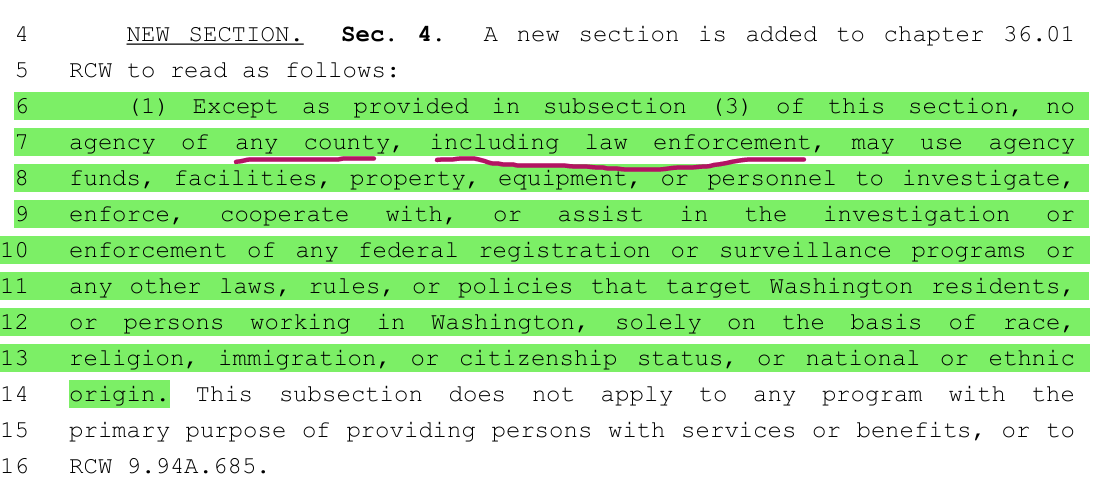
Section 4 applies the same restrictions to counties, extending sanctuary-style limitations across all major units of local government.
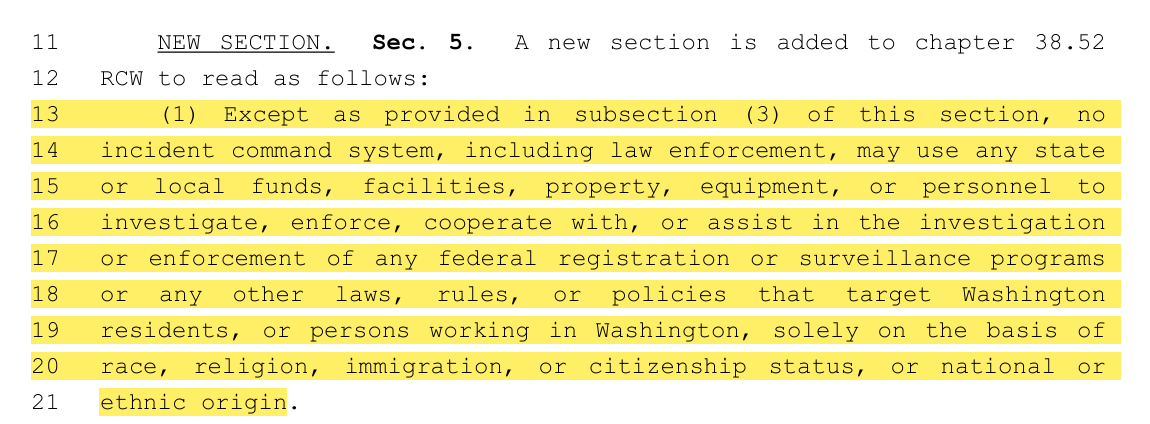
Section 5 goes further by amending Washington’s emergency management statute (chapter 38.52 RCW). It prohibits Incident Command System (ICS) teams from using state or local resources to assist any federal program that targets people based on immigration status or other protected characteristics.
That means immigration-related limitations are now embedded directly into the state’s emergency response framework.
Enforcement Power Centralized in the Attorney General
Section 6 creates a new enforcement and reporting pipeline to the Attorney General’s Office.
Agencies must report potential violations. The AG is given:
- Mandatory and discretionary notification authority
- Oversight power across jurisdictions
- Authority to publish public reports identifying violations
This centralizes enforcement in a single statewide office and adds public-pressure mechanisms to ensure compliance.
The Outer Layers: Emergency Zones and Expanded Obstruction Laws
Only after locking in the sanctuary framework does HB 2216 return to its headline topic.
The bill expands the obstruction statute to cover interference with any emergency responder, not just law enforcement. It also authorizes the governor and local executives to establish temporary Emergency Operation Zones (EOZs) during disasters.
Within these zones, law enforcement officers targeting emergency responders must:
- Identify themselves
- Disclose their purpose
- Obtain warrants for searches or seizures
- Avoid disrupting emergency work
Exceptions exist, but they’re narrow and primarily tied to violent-crime situations.
The Broader Agenda
HB 2216 is not a stand alone bill and is best viewed as part of a “package” of legislation along with SB 5852/HB 2105, SB 5855/HB 2173 and SB 5906. One set of bills expands “immigrant worker protections,” another restructures agency authority and limits cooperation with federal enforcement, another embeds immigration non-cooperation rules inside emergency response law, and still another restricts how law enforcement may operate in public-facing roles. Each piece reinforces the others. This is how Washington doubles down on sanctuary status. This is a clear agenda to limit cooperation with federal immigration enforcement, centralize oversight in the Attorney General’s office, restrict information-sharing, and normalize immigration status as untouchable across labor, local government, and emergency management. Citizens should watch these bills together because their combined effect is far greater than any single vote, it’s a deliberate effort to hard-wire sanctuary policy into the state’s legal and administrative infrastructure.
Washington Quietly Extends Sanctuary State Protections Into Election Offices
Conservative Ladies of America
·
December 18, 2025
We’ll be tracking these bills closely in Washington and beyond as the 2026 legislative session gets underway, keeping an eye on efforts to expand sanctuary policies. Stay informed, stay engaged, and make your voice heard. share this post and subscribe to get the latest breaking alerts, analysis, and calls to action as these agendas unfold across the country.